Why Gay Dating is Hard

In our current age, dating is extremely difficult–however, gay dating is even worse.

From a socialization standpoint, men are taught to bury emotions, hide anything that resembles humanity, and basically look for as many sexual conquests as you can possibly muster. From my personal experiences, the following occurrences are many of the issues I face while searching for a potential long-term partner.

(1) It’s All About the Apps

With the onset of all the available location based apps (Grindr, Growlr, Scruff, Tinder, ect.) it is easy to find someone with the simple swipe or press of your finger. In the way that men are available, it’s like shopping for a shirt–you can decide in roughly 2-3 seconds if you like someone based on nothing more than looks. There are so many viable people within a give proximity–especially if you live in a metropolitan area–that you can be extremely picky and have unrealistic expectations. In that respect, it’s easy to hide behind a glass screen and be mean or ignore people. The apps have taken away even more of our ability to make connections which tends to already be hard for men. The apps are not going anywhere anytime soon so we need to figure out how to navigate them in a positive manner.

(2) Everyone Wants Sex

Often, my experience has been that men just want sex. Even when the profiles say looking for friends, relationships, or connections, I get those 3AM messages asking: “Looking?” While we know everyone goes through phases of being horny, I find it interesting that individuals don’t bother to change their profile descriptions when their intent changes. I would also like to argue that sexual encounters can become serious relationships–I experienced this with someone I met through an app and we dated for about a year and a half. It can be hard to think with your brain and not your dick. I think the important thing is to make sure your expectations are clear. Engage in as much or as little sex as you want to but just be honest about your intentions–even if you don’t have any.

(3) Age–Where are the Adults My Age?

As a male who turned 30 this past year, I find most of the individuals on the apps are 18-24 or 42 and up. While I am not against dating someone younger or older (my last relationships was with someone who was 8 years my junior), I would like to meet someone around my own age. The 20s are really formative years for young adults and the 40s are more of establishment period for older men. The 30s are kind of a limbo and in between place where we have dealt with the hard shit of discovering who we are but maybe haven’t quite reached our career goals. I find that I don’t see a lot of men in this age range on the apps and wonder: Are they already in committed relationships? Am I looking in the wrong places? Do they even exist?

I am hopeful that there are decent guys my age out there but age seems to be one of the constant hurtles that I face. I would enjoy meeting someone at the same place in life–not meeting someone just starting out or someone who has it all together.

(4) Masc 4 Masc

Toxic Masculinity SUCKS. As men, we are socialized to believe that we must be these masculine, macho, burly men. I could literally write a whole dissertation on this topic–and maybe at some point I will. Basically, we are looking for these heteronormative prototypes of men rather than accepting people for who they are. People are not going to fit these stereotypes so if you are waiting for a man who resembles the celebrities and models you have come accustomed to and lust over, you will be sad.

(5) BMW–Body. Made. Wrong.

In the same frame of toxic masculinity, we think all bodies need to be hard and muscled. The expectations on body can be hard for all of us to deal with. Ultimately, like what you like but let’s not fat shame people. Often I see so many really handsome guys with self esteem issues about their bodies. These concerns are just as wide spread for men with muscles as they are for men with belly fat. Just remember, treat people the way you want to be treated. Your true love may not look like Chris Evans but more like Seth Rogen–let’s be honest, Seth would always make you laugh so I don’t think that a loss.


The five occurrences I listed, I am sure, are not unique to me. I would strongly encourage all of us (myself included) to stop looking past the men that we think may not be our type and get to know them. In a world full of options, we are lusting after men and making them our fetish when we barely know them!
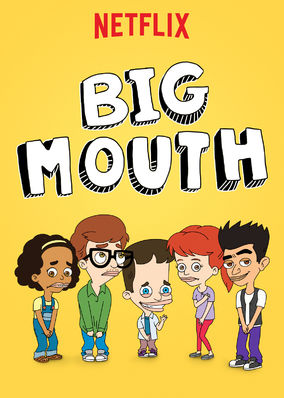


The Hormone Monster: How Netflix’s ‘Big Mouth’ Offers an Intelligent Insight into Puberty

**SPOILER ALERT: ‘Big Mouth” on Nextflix. Season 1 now available to watch***

5cb2d72193c925fc56503ef188a5f3f4e49281ed

When it comes to sexual education around young adults and puberty, there are a plethora of movies and resources; however, I would argue that many of those resources are not sex positive, lack essential details on navigating puberty, and focus on heteronormative assumptions. Netflix recently released “Big Mouth,” a show that follows the main characters, Nick and Andrew, two seventh grade boys that are experiencing puberty at different intervals. Andrew is currently dealing with his own hormones which have manifested itself as “Hormone Monster,” while Nick doesn’t seem to yet have acquired his own “Hormone Monster.”

What I personally loved about this show is that they deal with a whole gambit of issues that many adolescents face. Just to name a few: boys feeling inferior about penis size and body hair, male and female masturbation, untimely erections, menstruation, and navigating relationships.

While the show seems to be marketing itself as a educational show for adolescents on their way to puberty, I would argue that any parent review the entire show before allowing preteens to watch. At times, the show can be crude (language and innuendos) and graphic (if you find cartoon vulvas and penises graphic).

Additionally, while the show’s two main characters are two, 7th grade boys, we also have a great side story from their friend, Jessi. A 7th grade female, dealing with getting her first period, being tormented by her own hormone monster, and navigating her own personal family issues. I can honestly say, this is one of the first times I have seen a show that is also sex positive towards girls. While there are some stereotypes about how girls become emotional as they progress through puberty, how many shows feature an adolescent girl looking at her vulva and learning about her body?

(Photos courtesy of The RealReal)

Finally, the show has a gay character, Matthew, that for all intents and purposes, serves as a very stereotypical gay character. Matthew is fashionable, sarcastic, and sometimes a right down ‘mean girl.’ However, I was pleased that they included a gay character in the show. There is even an episode when Andrew thinks he may be gay and turns to Matthew for advice and help. I hope that as the series progresses, we will see some character development and insight into his own sexuality and experiences.

There are a whole plethora of other issues in the show that deal with coming out, pregnancy, consent, and marriage but I will leave out all of the details so there is something for you to still watch and be surprised about in the show.

On a final note, as a sexuality educator, I am so excited to see something this well done on a mainstream venue like Netflix. I hope that the show gets renewed for further seasons. I would also encourage anyone who teaches sexuality to look at this show as a possible education tool–especially a fantastic tool and resource for those looking to be educators themselves.


LGBT History Month 2017

I find it so hard to believe that October is upon us–2017 is quickly coming to an end but not before we take time to celebrate LGBT History Month. So you may be asking yourself, what is LGBT history month? Why is LGBT history important? Is there even such thing as LGBT history? According to George Chauncey (Samuel Knight Professor of American History and Chair of the History Department, Yale University),

“LGBT History Month sends an important message to our nation’s teachers, school boards, community leaders, and youth about the vital importance of recognizing and exploring the role of gay, lesbian, bisexual, and transgender people in American history” (LGBT History Month, 2017).

Often, the LGBT community is “not taught its history at home, in public schools or in religious institutions” (LGBT History Month, 2017). “LGBT History Month provides role models, builds community and makes the civil rights statement about our extraordinary national and international contributions” (LGBT History Month, 2017).

I find that LGBT history is so important to not only members of the community but to others as well. We need to celebrate all of the great milestones and accomplishments of our predecessors but continue working to build a better future. A place of understanding, acceptance, and equity.

Here are the list of 31 LGBT icons that are being celebrated for 2017: https://lgbthistorymonth.com/


Resources

LGBT history month. (2017). About LGBT history month. Retrieved from https://lgbthistorymonth.com/background


Transgender Military Ban: What Does This Mean?

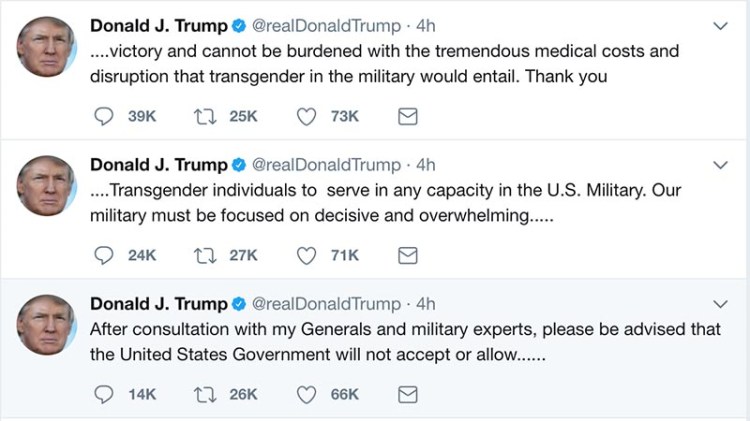
On July 26, 2017, Trump posted via his Twitter account, that the Military would no longer allow transgender individuals to serve our country (Twitter photo below).

TrumpTransgenderTweets.jpg

According to the Human Rights Campaign (HRC), this would mean that roughly 15,000 transgender individuals would be affected by this mandate (Peters, 2017). However, the current tweets reflect coming “policy change” and do not yet reflect the current policy (Sellers, 2017).

Historically, there have existed bans that have barred gay men and lesbians from federal employment; yet, this is different from that as sexual orientation and gender identity are two different concepts (Sellers, 2017). The Obama administration had begun working to remove the ban on transgender military service–allowing already-enlisted service members to serve openly, while civilian transgender individuals were still disqualified from service (Sellers, 2017). What this could mean is that if these Tweets become policy, open transgender individuals may either opt for a medical discharge or be dishonorably discharged from service (Sellers, 2017).

If you are wondering what the justification is for banning transgender individuals in the military, there does not seem to be a good answer. According to the tweets from trump, it is the costs of health care; however, several major journalist, press, and new outlets have found that the government spends more on erectile dysfunction medication (approximately 5 times more than the costs associated with health care for transgender individuals) (Kimble, 2017).

In my personal opinion, I believe that Trump is losing ground on all of the other promises he made to his constituents (“The Wall,” repealing the ACA, travel bans, and so on) that he is looking for a victory that will appease both Republicans and the Conservatives that bought his political platform during the election. There are already a number of local and state governments that have shown their support for the Transgender community and have offered positions to anyone who may be discharged from the military–should these tweets become policy. Agencies from local and state governments to police departs, are willing to offer supplemental work in the face of this very blatant discrimination.

We are living in a country where to be Trans* is often met with harsh stigma and in some cases even violence. As of January 2017, we have seen 18 reported and identified cases of Trans* individuals murdered–with other 80% of those being people of color (Violence Against the Trans Community, 2017). Our government and POTUS should be acting in the best interests of the Trans* community and not offering further discrimination and isolation from our society.


I am angry.

I am tired of bigotry.

I am ready to fight this Trump Administration.


References

Kimble, L. (2017). Costs for Transgender people in military’exceedingly small’ despite President Trump’s clam, study says. Retrieved from http://people.com/politics/transgender-soldiers-military-cost-donald-trump-claims/

N.A. (2017). Violence against the Transgender community in 2017. Retrieved from http://www.hrc.org/resources/violence-against-the-transgender-community-in-2017

Peters, S. (2017). Breaking: Trump launches all out assault on service members. Retrieved from http://www.hrc.org/blog/breaking-president-trump-launches-all-out-assault-on-trans-service-members

Sellers, M. (2017). The 4 key things you need to know about Trump’s proposed ban on transgender military service. Retrieved from https://www.washingtonpost.com/news/monkey-cage/wp/2017/07/31/the-4-key-things-you-need-to-know-about-trumps-proposed-ban-on-transgender-military-service/?utm_term=.08b385032221

Topless Women: Are Women’s Breast Offensive?

I recently got into a heated discussion with a family member via FaceBook about a topless rally that was schedule in West Virginia. While I can appreciate the discussion, I was hoping for a more educated argument from both sides. I decided that I needed to do some research and unravel the history behind why women’s breasts have become objects of sexual desire and why they need to be covered.

Why do we sexualize women’s breasts? Why is seeing a woman’s nipple considered offensive? Breasts have a fundamental nature of providing nourishment to babies, thus providing the essential nectar of life; however. over time, society has come to view women’s breasts as sexual entities, as objects of sexual desire, or sexual fantasy.

Historically, toplessness was part of humanity; it was much a part of the natural sense of being (Oyler, 2015). When we look at a more global perspective, it can be seen that breasts are more free–in that regard, women have more freedom to be topless and it is seen as socially acceptable (Joannides, 2015). The implementation of Western culture adversely affected being topless–whereas to be covered became a top of social class and religious practice (Oyler, 2015). During the Age of Enlightenment, Western culture began to demoralize nudity in public and by the 1900s, being topless became a criminal offense punishable by fines (Oyler, 2015). Laws prohibiting toplessness applied to both women and men (in America) until 1936 when laws passed allowing me to expose their chest an torso in public (Go topless, 2017). However, the laws regard toplessness in American have be very inconsistent–there exist public laws and court rulings that prohibit being topless in one state, another state may have a completely ambiguous law about being topless, and then you look at Utah which gives women the right to be 100% topless (Oyler, 2015). No wonder there is such widespread public discourse over the legal, ethical, and moral implications of women being topless.

What seems to be consistent on a global and cultural view is that those parts that are covered are what is seen as desirable (Joannides, 2015). Unfortunately, our society has utilized the allure of “those covered parts” as a commodity–breasts are then sexualized and become a profitable commodity for various forms of business (Kam, 2015). Women’s breast are used to market, sell, and promote various products and services; thus, breasts have become a sort of sexual taboo where showing just is enough is alluring but showing too much is offensive (Kam, 2015). There is definitely a reason that the words “sex sells” have widespread recognition and clout (Joannides, 2015; Kam, 2015).

The “enforced concealment of women’s breasts reinforces cultural obsession with them, contributes toward unhealthy attitudes about breasts by both sexes” (Joannides, 2015).

The above statement has never rang more true–that mentality was the reason for the discourse I had via FaceBook. I personally do not find women’s breasts to be offensive and do not think anything of those who chose to go topless. We have been ingrained, since before birth, about prescribed gender norms–we often forget that these norms are culturally created phenomenon that has no basis in our biological self. Rather, we have created a set of cultural norms, expectations, and gendered ways of being that have persisted over time. However, as culture has evolved, the norms no longer make sense as rules that must be followed. Women are simply looking to be equitable to men in our society–because of the commodification of women’s bodies, they “have to” remain covered in society for this commodification to persist.

So to my family member I would say, you are spilling a set of beliefs that someone decided for you–you are simply being used by the system to keep subjecting women as sexual objects. I would strongly encourage you, or anyone else, to really think about why you find women’s breasts to be offensive. In actuality, why are you offended by the nipples of women? Really, that is what this all boils down to–women’s nipples are what we seem to be offended by. Again, I believe this goes back to the history of culture and the now present commodification of women’s bodies.

Additionally, of the many points you made in our discussion (see the pictures for more detail), your notion that “men will be men,” hurt not only women but men as well. Our society justifies that our predispositions for behavior are somehow linked to our genitals; that being male or being female is innate to our biological self and we cannot change. I find this argument to be extremely weak and annoying due to the sheer nature of varying culture across the globe. If gender was innately linked to our biology, then everyone (across cultures and geographic location) would behave the same–we wouldn’t have a choice. Instead, we are faced with a society of individuals who think like you and hurt not only women but men too–because men cannot learn to see a topless woman without seeing her as sexual and desirable. *Rolls Eyes*

Ultimately, all I ask is that we stop treating women as deviants for wanting the ability to be topless in public spaces. It took men revolting almost a 100 years ago to garner that right. I think it is time for women to be allowed the same


References

Go Topless (2017). Timeline. Retrieved from http://gotopless.org/timeline

Joannides, P. (2015). Guide to getting it on: A book about the wonders of sex (8th ed.). Saline, MI: Goofy Foot Press.

Kam, R. (2015). The sexualisation of breasts-what has it caused. BellyBelly. Retrieved from https://www.bellybelly.com.au/breastfeeding/the-sexualisation-of-breasts/

Oyler, L. (2015). How toplessness became a bottomless controversy. Boradly. Retrieved from https://broadly.vice.com/en_us/article/43gy7n/the-history-of-toplessness


My Experience at DC Pride

On June 10th, I attended my first ever DC Pride. I am rather introverted and tend to feel uneasy in large crowds; however, as I quickly approaching my 30th birthday (as in next month), I thought it was time to finally attend my first ever Pride. While I reside in Philadelphia, I chose to attend DC pride for several reasons: (1) I have heard, time and time again, that DC pride is one of the best to attend, (2) My partner’s old college roommate lives near DC so free housing for the weekend was awesome, and (3) The grad coordinator from my Masters program was taking a group of students for a class he was teaching so I got the chance to reconnect with some old friends and colleagues.

I decided that I would be attending the parade on Saturday and that would be the extent of my Pride activities. I was thinking about just sticking my toe in the water rather than diving head first into the experience and possibly drowning. I traveled with my partner and his old roommate on the metro–about 20 minutes or so to DuPont Circle. When we arrived I was floored at the amount of people that actually attend this event–there were so probably about 100+ people trying to make their way from the metro station up the escalator.

When we arrived above ground, there were so many people everywhere and this both excited and terrified me. I was excited to see so many different people from so many diverse backgrounds and identities being represented–many of which I am sure I would not be able to completely explain just by sight. I was enamored to see so many people playing the boundaries of gender–I had never seen such displays of gender bending in such a public space as DuPont Circle. The fact that even in this political climate we live in, people are brave enough to live their true self, is amazing and empowering to me. I saw so many states of dress and undress but nothing that I would say shocked me.


While on route to the parade, we came across a person who was “preaching” about the immorality of our behaviors, ways of being, and our need to cleanse ourselves of this sin. The individual was standing on a box, screaming to all who would listen. What I didn’t notice until I got closer to the speech was that a group of individuals were standing around him–they were holding signs that didn’t necessarily protest his speech but rather affirmed that we have the ability to exist as we are without the need to justify ourselves. I liked that rather than fight with this individual, this group of people chose to demonstrate in a way that was positive to individuals attending the event.

When we finally got to the parade, we found a nice shady spot and proceeded to enjoy the event. We saw so many different individuals from all walks of life–I have included a few photos below for your enjoyment (In my amazement, I took very few pictures so I borrowed all but one of these from my friend Jo Forrest-Stuart).

All in all, I had a great experience and I think next year, I would like to maybe attend more events. I owe a lot of my ability to be comfortable in a sea of so many individuals to the amazing people that were there with me. Thank you Dr. Richard Stevens for inviting the alumni of the CSDA program. I will remember this experience with fond memories and cannot wait to see what is in store for next year.

When Your Employer is Constantly Passing you Over: Change the Game

My employment history has been extremely rocky in the past 4 years. I owe that a lot to the fact that I completed my undergrad and graduate degree at the same institution. I wasn’t extremely prepared to transition away from the place I had been at for 7 years and as a result, I have held 5 positions in the past 4 years. I am fortunate for the experiences I have had and am fortunate to be employed but I constantly feel like I am being passed up for work opportunities at my current employment.

When I began my current role as an Academic Advisor in November 2016, I was so excited to be back in the academic side of higher education administration—most of my career has been in student affairs, mostly in residence life, and I was burned out. At my current institution, I was fortunate enough to apply for an international education opportunity where we were trained to work with international students at our institution and understand the nuances of being an international student abroad. I had to apply for this opportunity  and was fortunate enough to be selected; thus, I was extremely excited to be a participant. When other opportunities have come up to apply I have done so and time and time again I have not been selected.

The first opportunity came in February when they asked for volunteers to sign up to spend spring break at our Rome or Japan campuses. I applied thinking that maybe I had an opportunity as a new staff member and had never been on the trip before. What I found instead is that those selected were staff who had worked at my institution for a number of years that had been selected—some individuals selected were higher up administrators that have little to no interface with students. I thought maybe it was a seniority thing and they chose people who had been at my institution since that had “paid their dues.” I was disappointed but determined to keep working hard towards my goals.

The second opportunity came when I applied for an international grant to travel abroad to promote my institution and my department. I worked on the grant for a few weeks, got lots of feedback from my supervisor, and even had input from our Vice Provost. Again, my grant was not selected. Now before you say “maybe this was your first time ever writing a grant,” I would like to point out that I have previously written three grants and all were successfully funded—landing close to $30,000 in funding for institutional diversity education. Therefore, for lack of a better phrase, “this isn’t my first time at the rodeo.”

While I sit here disappointed yet again, I am thankful for the many other opportunities I have been afforded in my short career in higher education.

First, how many people can say that have been able to transition out of student affairs, much less residence life, in the short amount of time I have had in the field. Residence Life Professionals tend to get termed as “Res Lifers” and are normally pigeonholed into that particular field; however, my first job as an academic advisor came when I transitioned into an advising role for undecided students and I was remembered for a housing job I had previously applied for. I owe my current role to those people that took a chance on me and I am forever grateful.

Next, I have been afforded the opportunity to move into different roles and jobs in the past four years. Despite my track record, institutions have continuously given me opportunities for employment and I feel that I have been successful in a majority of those roles. Sometimes I have taken a position that better suited my skill set and not necessarily my interests—I think understanding that you can find a job that works to your skills and interest is very important to realize early on. There are definitely times when you may have to take a job you do not want but if you are already gainfully employed, I implore you search until it is the right job not just a job. Regardless, I have held a number of interesting positions in my short time in higher education and I am very grateful to have do so.

Lastly, I have come to understand that what we may want at the time is not what we want or need—A.K.A., there are other opportunities that are waiting for you that you are not aware of yet. While I was feeling sorry for myself over these minor “failures,” I was given some other opportunities in my current role and to expand beyond my typical work day. (1) Teaching—I will be teaching a university seminar at my current institution in the Fall. While this is not a new type of experience for me, I am excited to teach this course at a new institution. Additionally, I was given the opportunity to teach a 3-credit course that counts as a general education course for students. For the first time in my professional experience, I will be getting paid to teach! I am more than excited for this opportunity and cannot wait to being prepping for my course. (2) Committees—I have been involved on several committees and been given opportunities to expand my presence at my current work. Committees can sometimes be tedious but I find that they are great for getting you out of the office for a bit and provide the opportunity to network. (3) Professional development—I was recently allowed to participate in a regional conference (at no cost to me) and I additionally presented at an institutional professional development opportunity. The experiences help not only my resume but aid in networking and improving my performance in my current role.

While my victories may be small they are still victories. I, for one, have a hard time keeping positive and I again try to remember that it’s my failures that can still make me successful because they teach me more than the successes. At the end of the day, I try to remember that it is not how many awards you get, how many things you are selected for, or how much you look like a rock star but rather it you attitude and perspective—you make the choice to be miserable, unhappy, or indifferent to your work and even your life. Simply put, I come to work every day because I love working with students not because I need another certificate to hang on my wall.

Coming Out is a Process

Recently a friend of mine came out to his family and things definitely didn’t go as planned. He had great hopes that his parents would be understanding and accepting but so far he’s received a lot of confusion, shock, and anger. While he is trying to decipher all of this, he still has to deal with his parents and the plethora of questions that exist. While

While doing some research I came across a great guide that I wanted to share some points from that might help anyone who may be struggling.

The Stages:

  • shock
  • denial
  • guilt
  • expression of feelings
  • personal decision-making
  • true acceptance

Caution: Each family is unique. Allow some variation for your own parents–they may follow the stages listed below or they may not.

Safety is your number one concern; only come out when you are sure your personal safety would not be jeopardized.

THEY’LL EXPERIENCE LOSS

Parents and Children Switch Roles

When you come out to your parents, you may find your parent-child roles reversed for a while. They will need to learn from your experience. As your parents deal with your disclosure, you must assume the “parenting” role by allowing them time to express their feelings and make progress toward new insights.

This will not be easy. You’ll want them to understand and grasp this important part of your life right away.

It will be easy for you to become impatient. You’ll need to repeat many of the same things. Just because you’ve explained something once does not mean they heard it. Their understanding will evolve slowly–painfully slowly–at the beginning. Their emotional reactions will get in the way of their intellectual understandings.

STAGE 1: SHOCK

If They Have No Idea About You

An initial state of shock can be anticipated if you suspect that your parents have no idea what you’re about to share. It may last anywhere from ten minutes to a week; usually it wears off in a few days. Shock is a natural reaction that we all experience (and need for a while) to avoid acute distress and unpleasantness.

Explain that you haven’t been able to be completely honest with them and you don’t like the distance that has occurred over the years. Affirm your love for them. Say it more than once. Although they may not initially respond positively to your profession of love, it will penetrate in the hours when they are alone and thinking about it.

Remind them that you are the same person today that you were yesterday: “You loved me yesterday, before I told; I haven’t changed since then. I’m the same person today that I was yesterday.”


STAGE 2: DENIAL

A Shield from Threat

Denial helps to shield a person from a threatening or painful message. It is different from shock because it indicates the person has heard the message and is attempting to build a defense mechanism to ward it off.

Denial responses take many forms: hostility (“No son of mine is going to be queer.”), non-registering (“That’s nice, dear, what do you want for dinner?”), indifference (“If you choose that lifestyle, I don’t want to hear about it.”), or rejection (“It’s just a phase; you’ll get over it.”).

Their perception of your orientation or gender will be distorted by the messages they’ve received and accepted from our homophobic and transphobic society. The manner in which the denial is expressed can range from a serene trance to hysterical crying or shouting. Many parents take a middle-of-the-road approach; they cry frequently.


STAGE 3: GUILT

They’ll Feel They’ve Done Wrong

Most people who deal with homosexuality initially perceive it as a “problem” and ask: “What causes it?” They think if they can locate a cause, then a cure is not far behind.

For me, the question became introspective: “What did I do wrong?” Whether I viewed the cause as genetic or environmental, I was clearly to blame. I questioned the kind of male role model I had provided; I examined my masculinity.

For a while, no matter which angle I viewed the situation from, I believed I was the primary source of the problem. It was a feeling I was too ashamed and saddened to share with anyone else. Although both parents usually feel guilty, the parent who is the same gender as the child probably feels it more.

Then one day, my wife said: “I don’t think it’s reasonable for you to take the blame; you raised two sons, one gay and one straight. There must be other factors involved.”


STAGE 4: FEELINGS EXPRESSED

They Acknowledge Their Emotions

When it’s clear that guilt and self-incrimination are unproductive, parents are ready to ask questions, listen to answers and acknowledge their feelings. This is the point at which some of the most productive dialogue between you and your parents will take place.

Now will pour forth the full range of feelings: “I’m disappointed that I won’t have any grandchildren.” “Please don’t tell anyone in the family; I’m not ready to face this issue with anyone else.” “I feel so alone and hurt; I believe I was better off not knowing” “How can you hurt us this way?”

Since living in a homophobic and transphobic society has forced you to experience many of the same feelings (isolation, fear of rejection, hurt, confusion, fear of the future, etc.), you can share with them the similarities in the feelings you have experienced.

However, allow them ample time to express themselves; don’t let your needs overpower theirs. If they haven’t read a book or talked to other parents, suggest again that they pursue one of those avenues. Offer to read and discuss a chapter in the book with them or to go to a parents’ meeting with them.

Anger And Hurt

Anger and hurt are probably the most frequently expressed feelings. They are often surface feelings that seem spiteful and cruel. In order for your parents to make progress it is better that they express them than bury them and attempt to deny their existence. This will be hard for you to handle. You may be tempted to withdraw, regretting that you ever opened up to them.

Hang in there, however; there’s no turning back now. When they begin to express these feelings they’re on the road to recovery.

STAGE 5: MAKING DECISIONS

The Fork in the Road

As the emotional trauma subsides, your parents will increasingly deal more rationally with this. It’s common at this point for them to retreat for a while and consider the options that lie ahead.

It’s like reaching a fork in the road that has a number of paths from which to choose. The choice each person makes is a reflection of the attitude he or she is ready to adopt in dealing with the situation.

Both parents may not necessarily choose to take the same path. A number of factors will influence which path is chosen. Reading about queerness and talking to other parents will probably encourage them to take a more supportive position. Their religious affiliation will play an important part. The general liberal or conservative position they usually hold will also have some bearing.

The importance of the restoration of their relationship with you is a major factor. A variety of factors will affect them as they formulate a compatible posture for dealing with this. Three kinds of decisions will be described:

**All material is property of the Pride Resource Center at Colorado State University

https://prideresourcecenter.colostate.edu/resources/coming-out-to-your-parents

A Privileged Lens: Staying Out of Politics

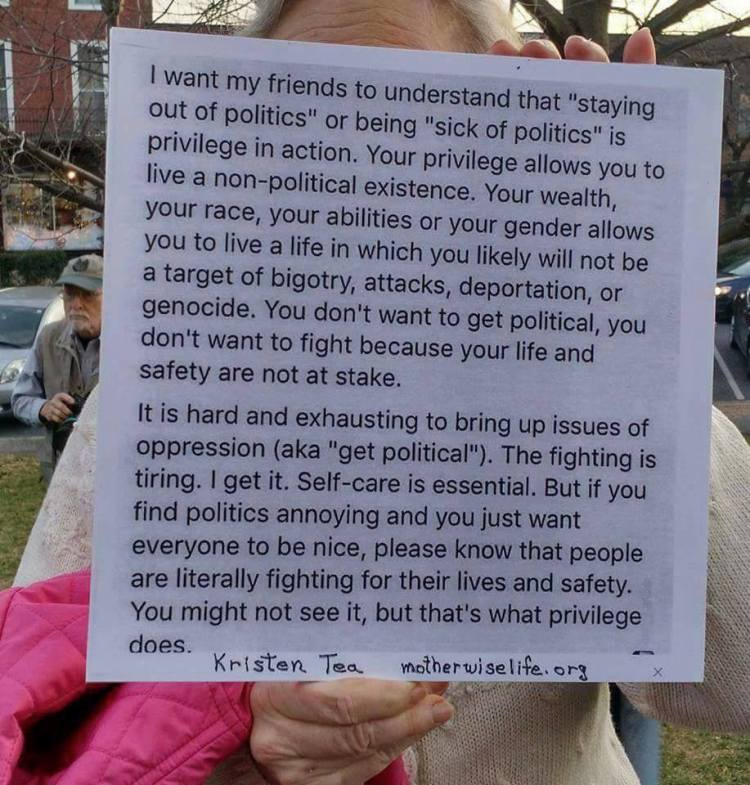
Kristen Tea (certified wellness coach, author, and administer/owner of the popular MotherWise blog and Facebook page) recently posted on her FaceBook page a very popular quote that has gone viral. Here is her infamous quote:

18057938_10156112778498327_8999355245099670865_n

When I first read this, I felt so many emotions–excitement, empowerment, validation, anger, heard, and included;  these are few that come to mind as I sit here and write. I have seen so many people writing about being uncomfortable about the politics on social media and have opted to “take a break” or deactivate their account. While I agree that self-care is important, you can’t opt out of everything because you are uncomfortable or annoyed. There are millions of people fighting for civil rights and liberties–being nice isn’t going to achieve that.

Basically, those who make up the 1%, those who have varying levels of societal privilege, those who have never been impacted by the many -isms that constitute our society, are somehow offended, annoyed, disgusted, or exhausted by the voices of the oppressed to be heard. As nicely as I can say this, Get over it…

The system in place has been telling those whose very identities are constantly being treated as delinquency, immoral, wrong, or disgusting to get “Get over it” since the beginning of our existence.  Now is the time for those disenfranchised groups to stand up and shout it back to you…”WE ARE HERE! YOU CANNOT IGNORE US! WE ARE STAYING HERE! GET OVER IT!”

I can only speak from my limited marginalized existence as a gay man, but I am exhausted from constantly be portrayed so negatively in our society. I am exhausted that we have to keep having the same conversations over and over about equity. I am exhausted that extreme religious ideologies continue to demonize so many. I am exhausted that you are constantly complaining that we are trying to be heard.

If you want FaceBook to be nice, make things right in our society and stop the same cycle of oppression, bigotry, and hate–realize that civil rights are human rights.

I’ll leave you with one of my favorite quotes:

“I believe that there will be ultimately be a clash between the oppressed and those who do the oppressing. I believe that there will be a clash between those who want freedom, justice and equality for everyone and those who want to continue the system of exploitation. I believe that there will be that kind of clash, but I don’t think it will be based on the color of the skin…”
― Malcolm X

At The Gym

I came across a funny cartoon last year from The Oatmeal, entitled “At The Gym: Whom Is Looking at Whom.” I think the cartoon still holds a lot of relevance as we think about body envy and internalized hate. I know I constantly suffer with body image issues and I enjoyed the humor and relevance from the post.

Check it out here